Jobs & Skills Australia Has Spoken: A Guide to the Official Government Report on the AI Workforce
Aug 15
/
Sam Sperling
A landmark report has just been released by the Australian Government, and we’ve dug deep into its 125 pages to spare you the time, providing the clearest roadmap yet for the career landscape our children and students will navigate. For anyone in the role of a mentor, this is essential reading.
The ground is shifting beneath our feet. The rise of Generative Artificial Intelligence (Gen AI) is not a distant sci-fi concept; it’s a present-day reality that is actively reshaping our economy and society. For the young people we guide — our students, our children — this transition presents both profound opportunities and significant challenges. A comprehensive new report from Jobs and Skills Australia, titled “Our Gen AI Transition,” cuts through the hype and provides a data-rich look at what’s truly happening in the Australian labour market. It’s a guide to the future, and its insights are critical for every teacher, academic, and parent.
HYBRID: THIS ARTICLE HAS BEEN Responsibly CO-written with AI
The ground is shifting beneath our feet. The rise of Generative Artificial Intelligence (Gen AI) is not a distant sci-fi concept; it’s a present-day reality that is actively reshaping our economy and society. For the young people we guide — our students, our children — this transition presents both profound opportunities and significant challenges. A comprehensive new report from Jobs and Skills Australia, titled “Our Gen AI Transition,” cuts through the hype and provides a data-rich look at what’s truly happening in the Australian labour market. It’s a guide to the future, and its insights are critical for every teacher, academic, and parent.
The Big Mythbuster: It’s Not Replacement, It’s a Partnership 🤝
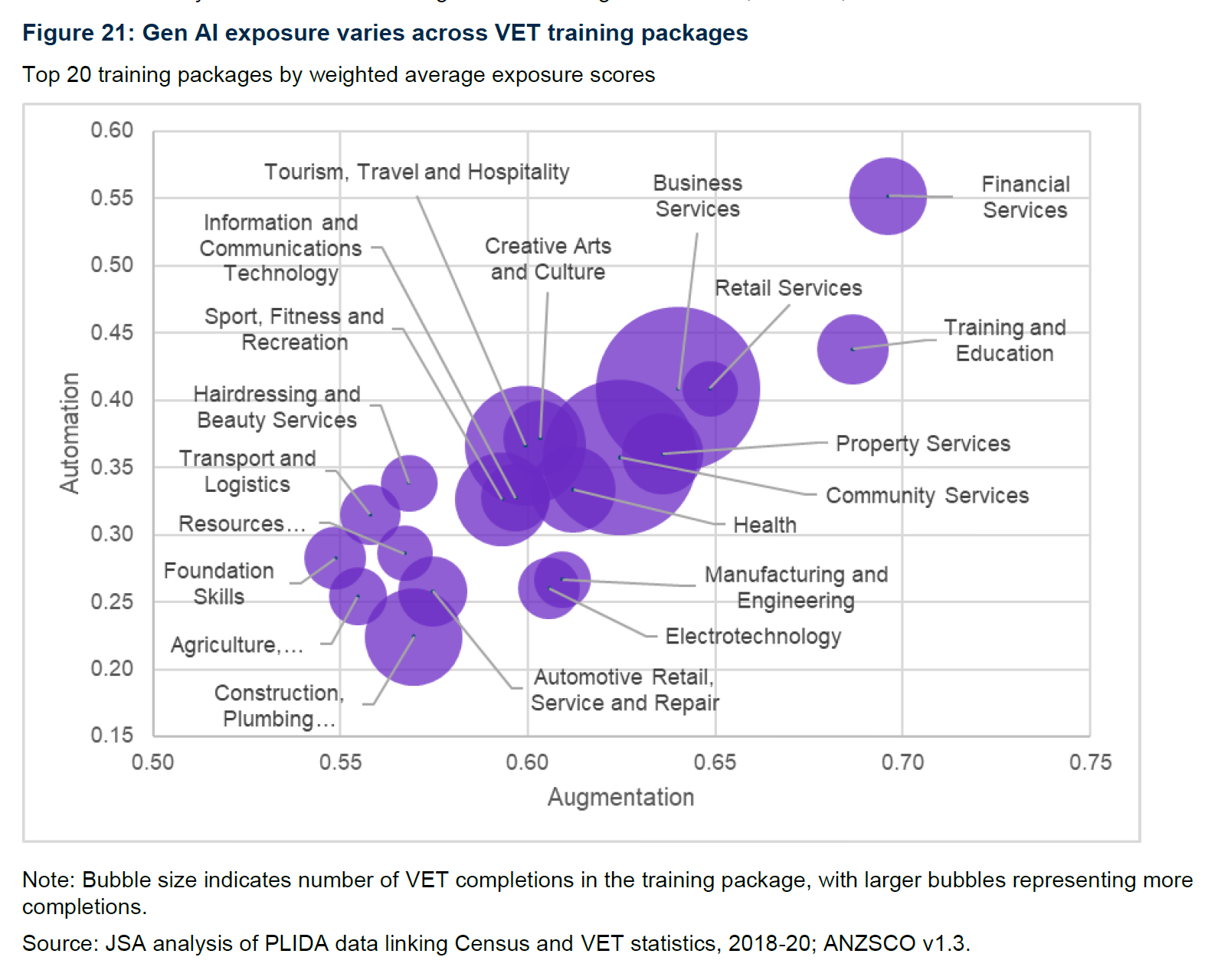
The dominant fear surrounding AI is one of mass job replacement. However, the report’s most crucial finding paints a different, more optimistic picture: the primary impact of Gen AI is far more likely to be augmentation rather than outright automation.
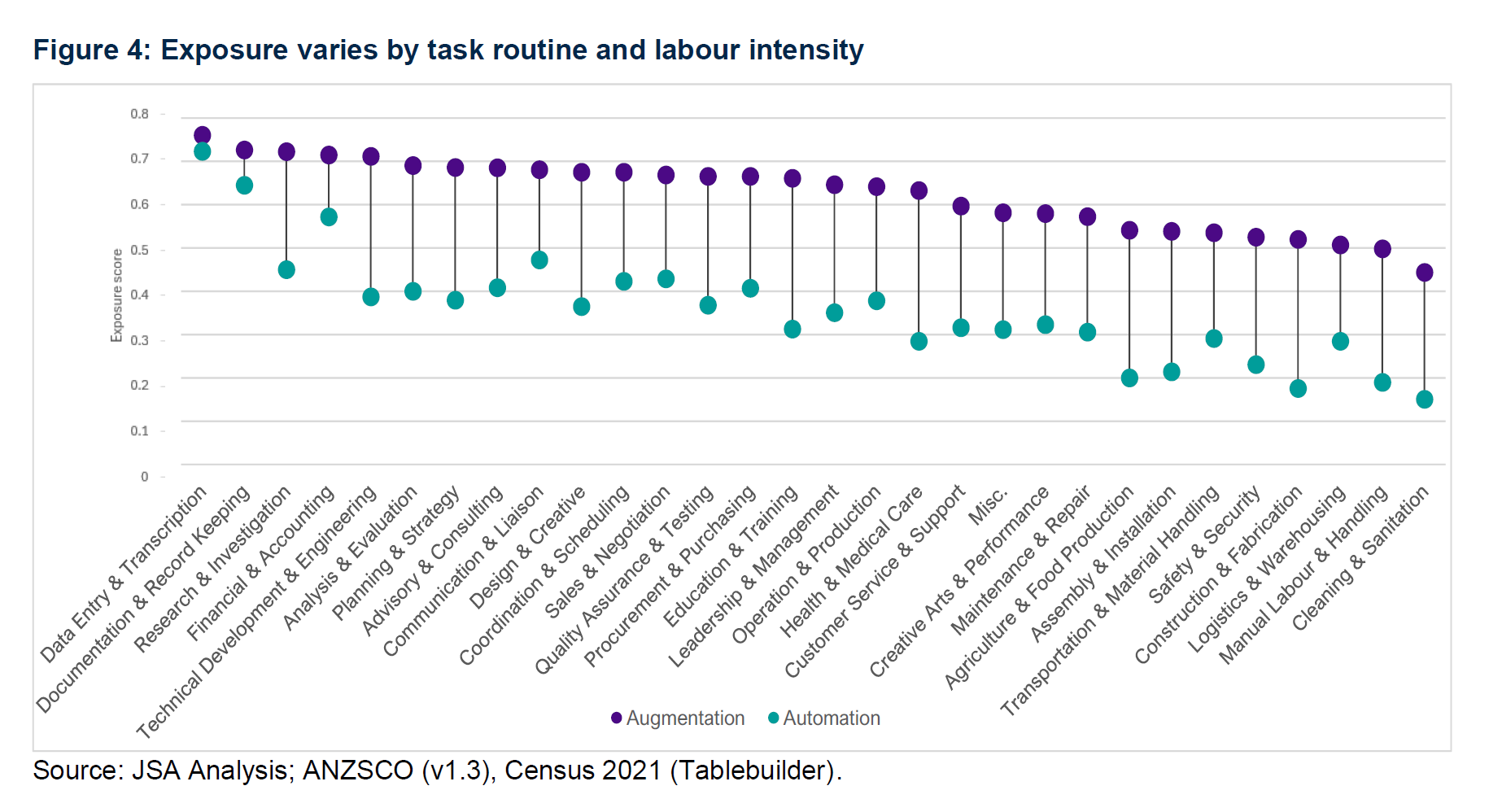
Think of it less as a robot taking over, and more as a human gaining a powerful co-pilot. The report's most powerful finding reveals a dramatic contrast between two key ideas: automation (where AI replaces human tasks) and augmentation (where AI assists human tasks).
The data tells a clear story: only 21% of the Australian workforce is in roles with medium-to-high exposure to automation. In stark contrast, a massive 87% of the workforce is in roles with medium-to-high potential to be augmented by AI tools. The future, therefore, is far less about being replaced and overwhelmingly more about learning to work with technology to become more effective.
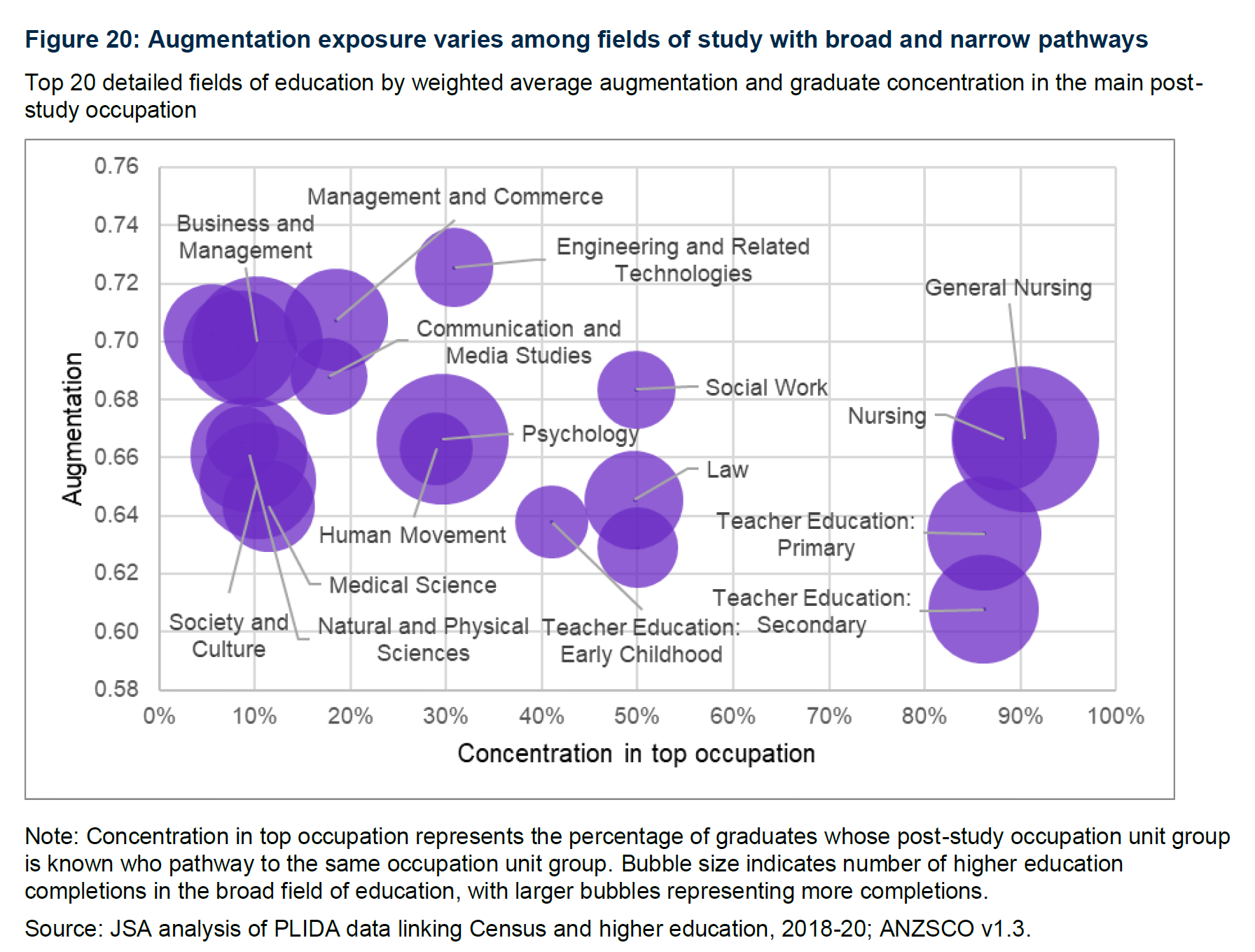
This means our students won’t be competing against AI; they’ll be expected to work with it. The technology will handle routine elements of their work, freeing them up to focus on tasks requiring deep expertise, creativity, and human judgment. This is especially true for higher-skilled, knowledge-based professions. The report shows that occupations at the highest skill levels (ANZSCO skill levels 1 and 2) have the greatest propensity to be augmented by Gen AI, transforming fields from engineering to education.
The New “Must-Have” Skills for a Future-Proof Career 🧠
So, if AI is the new partner at work, what skills will make our students the best collaborators? The report provides a clear answer: the future belongs to those who blend sophisticated human skills with a new level of digital fluency.
The Irreplaceable Value of Human-Centric Skills
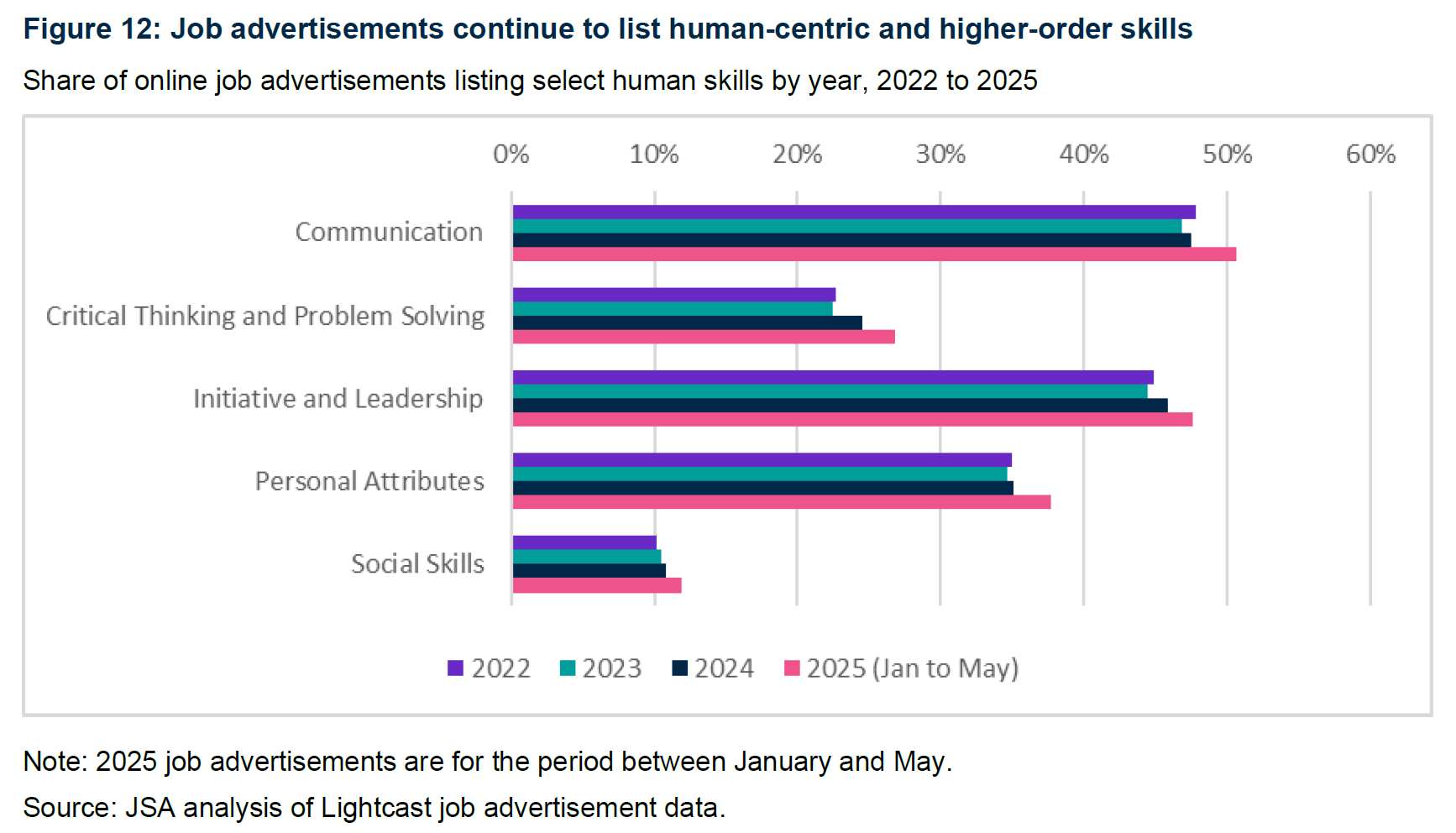
As technology automates the routine, our uniquely human capabilities become our greatest asset. A fascinating analysis in the report shows a direct correlation: the more a job can be augmented by AI, the more employers are demanding human-centric skills. The most sought-after capabilities include:
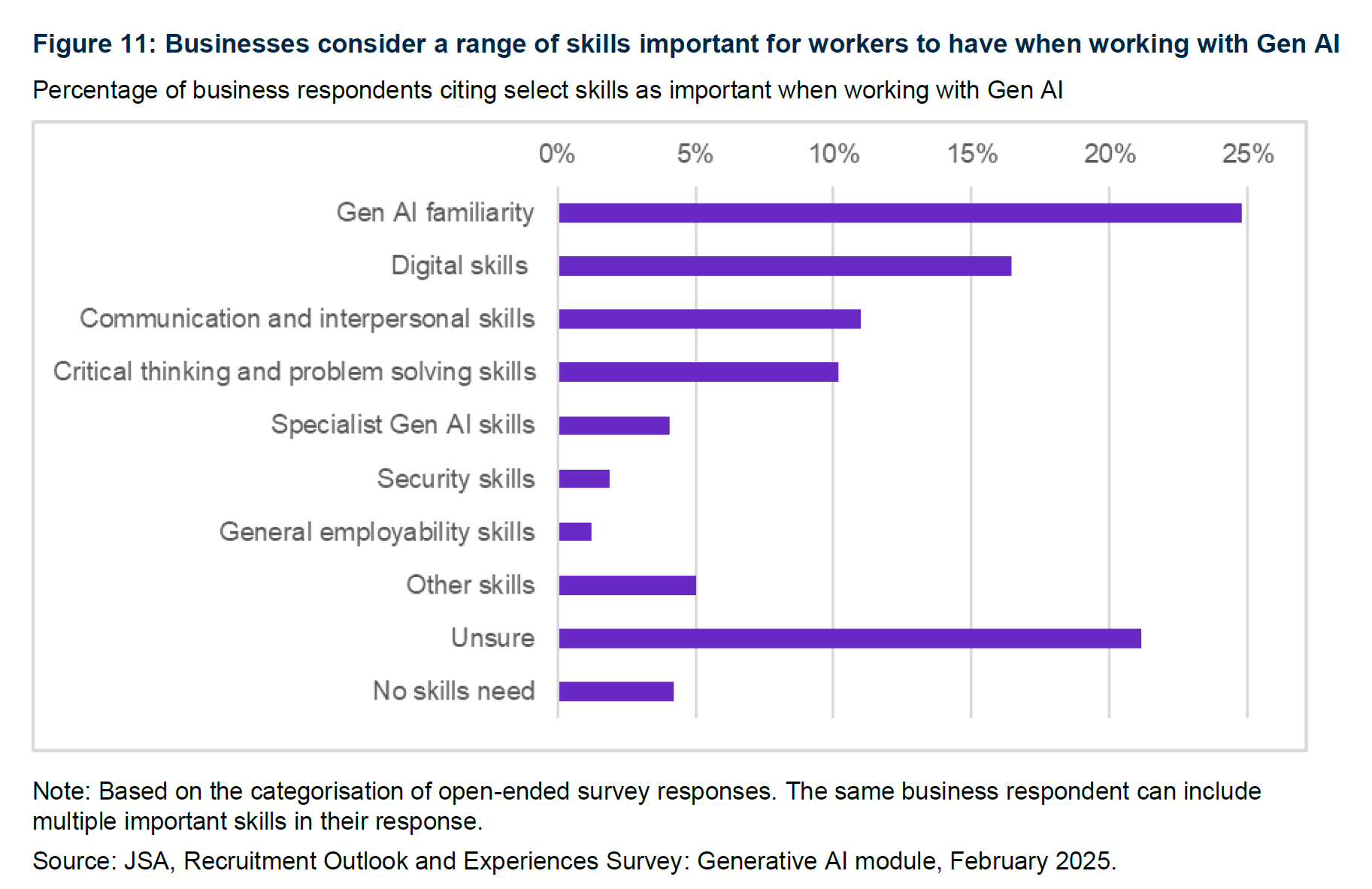
Critical Thinking & Problem Solving: Businesses surveyed for the report overwhelmingly cited this as a vital skill for workers using Gen AI. The future isn’t about knowing all the answers, but about asking the right questions and critically evaluating AI-generated outputs.
Communication & Interpersonal Skills: Technology can generate a report, but it can’t build trust with a client, empathise with a patient, or collaborate effectively with a diverse team. As one stakeholder from the retail sector noted, “interpersonal skills such as empathy, problem-solving and communication will become increasingly valuable as they complement AI capabilities”.
Initiative & Leadership: The report shows a strong link between highly augmentable jobs and the demand for leadership and initiative. The workers who will thrive are those who can proactively identify opportunities to use AI and lead their teams through change.
The Spectrum of AI Fluency
It’s no longer enough to be just a “user” of technology. The report identifies several “personas” in the new world of work, from Gen AI Leaders who set strategy, to Gen AI Professionals who build the tools, and Gen AI Enabled Workers who use the technology in their daily roles.
While not everyone needs to be a coder, a baseline of digital and AI literacy is becoming a foundational skill, as important as literacy and numeracy. Students need to understand not just how to use these tools, but also their limitations, their ethical implications, and the importance of data privacy.
What’s Happening on the Ground? 🤫 The Surprising Truths of the AI Transition
Interestingly, this transition isn’t just theoretical; it’s happening now, often in unexpected ways.
One of the report’s most intriguing findings is the rise of “shadow use”. A significant number of Australian employees are already using Gen AI tools to improve their own productivity, often without their employer’s knowledge or formal approval. This grassroots adoption shows that the workforce is not resistant to change; in fact, they are often leading it.
For those organisations that have formally adopted AI, the early results are promising. Businesses report significant time savings and improvements in the quality of work. One human services organisation noted the immense potential for AI to reduce the “rising administrative burden,” which is a major source of burnout, and allow skilled practitioners to “focus on the person-centred work they value most”.
The Evolution of the Career Ladder: Entry-Level Jobs & the New Value of Experience
What does this all mean for a young person just starting out? The report addresses the critical question of entry-level jobs head-on.
While some junior tasks may be automated, the data so far shows that the overall share of entry-level roles in Australia has remained stable. The nature of these roles, however, is likely to shift. A junior employee may spend less time on routine data entry and more time overseeing AI-generated outputs, requiring more judgment and domain expertise earlier in their career.
Perhaps most profoundly, the report suggests that AI will change how we value experience itself. In occupations with a very high rate of skill change, the value of experience may peak earlier, placing a premium on continuous upskilling and lifelong learning. For our students, the idea of “finishing” their education will be replaced by a career of constant adaptation, where short-form training, micro-credentials, and on-the-job learning become the norm.
Our Role as Mentors: Stewarding the Next Generation
The report concludes with a powerful call for a coordinated, national approach to steward this transition. But stewardship isn’t just a job for governments; it’s a role for all of us. As teachers, academics, and parents, we are the front-line mentors for the future workforce.
Here’s how we can act on these insights:
Champion a Balanced “Skills Portfolio”: Encourage students to pursue their passions, whether in STEM, the arts, or humanities. Emphasise that a combination of technical literacy and deep human skills will be the most potent recipe for success.
Foster Critical AI Literacy: Move beyond just teaching how to use AI tools. Create opportunities for students to debate the ethics of AI, analyse its biases, and learn to use it as a responsible, discerning professional.
Promote Adaptability as a Superpower: Frame lifelong learning not as a chore, but as an exciting, essential part of a modern career. Encourage participation in internships, industry projects, and short courses that build real-world, adaptable skills.
Reassure with Real Data: Use the findings from this report to counter fear with facts. The future is not one of human versus machine, but of human-machine collaboration. Our role is to prepare our young people to be the best possible collaborators.
The Gen AI transition is a defining moment for our society. By arming ourselves with the insights from this report, we can move beyond anxiety and speculation, and instead provide the clear, confident, and data-informed guidance our students deserve. We can help them build careers that are not just resilient to change, but are enriched and empowered by it.
Nurturing our Architects of the Future
Navigating this new skills landscape can feel daunting, but it also presents an incredible opportunity. The government’s report provides the ‘what,’ and at People Squad, we deliver the ‘how.’ We are dedicated to empowering young people to become architects of their AI-powered future, not just passive users of technology. Our programs, like the immersive ‘Your AI Future’ course, are specifically designed to cultivate the essential human-centred skills as well as making the most of AI, that this report proves are now invaluable. Through project-based learning and real-world challenges, we bridge the gap between knowing about AI and having the confidence to build with it. Partner with us to help your students build the skills they truly need to thrive.